Gramco Representative Atsuro Yamada gave a lecture at the Nikkei ESG Management Forum Study Group





On April 6, 2021, Nikkei BP held the Nikkei ESG Management Forum Study Group, titled "Study Group 3: Reading the Latest Issue of Nikkei ESG." Gramco Representative Atsuro Yamada served as a lecturer in a dialogue format with Toshiyuki Sugiyama, Chief Researcher, Nikkei BP Research Institute, on the topic of "Purpose Branding, Why It Is Needed Now."
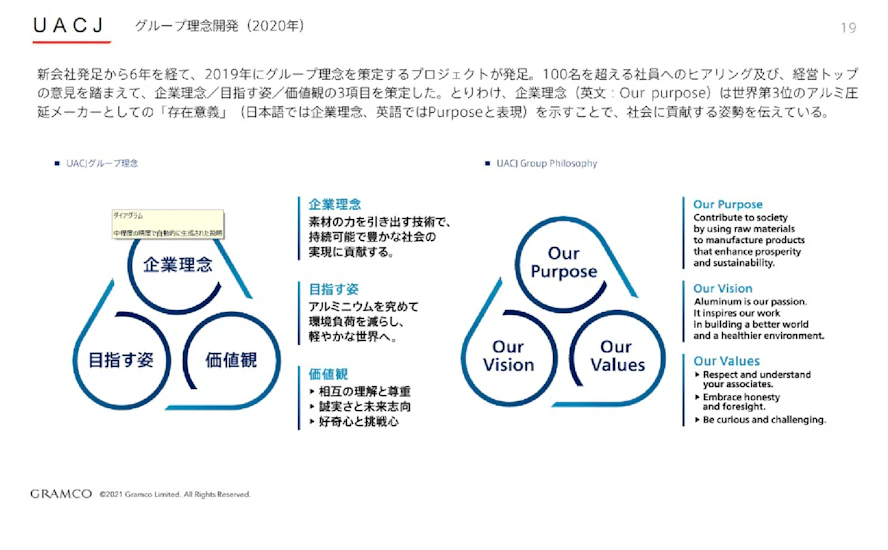
The workshop was held in a "semi-open" format online and attended by approximately 200 participants, including members of the Nikkei ESG Management Forum and those invited by the Forum. Following the session's introduction of Gramco, the speaker elaborated on "Purpose Branding," a topic that is increasingly gaining traction among companies, using case studies.
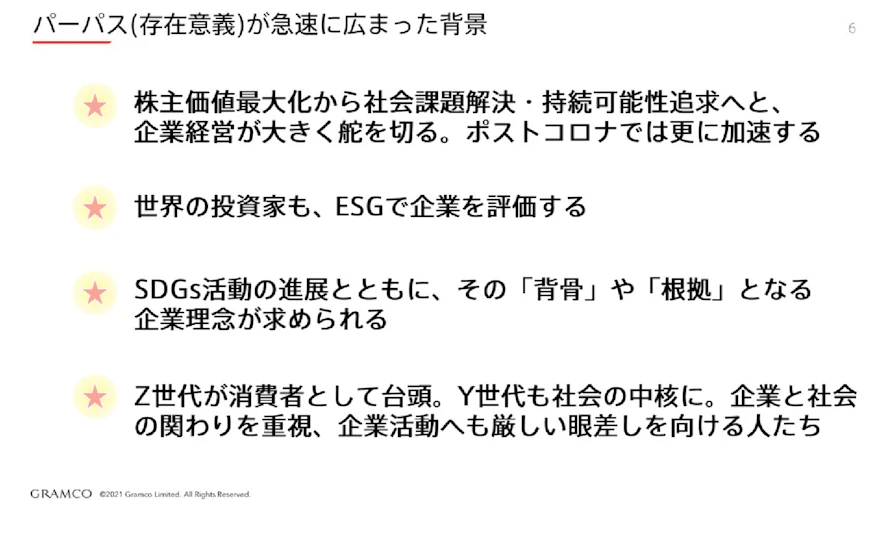
In Europe and the US, an increasing number of companies have been adopting the concept of purpose as the foundation of their corporate philosophy systems, replacing the traditional mission statement (MVV) over the past decade. Likewise, in Japan, an increasing number of companies, including the Toshiba Group, which Gramco has supported since 2019 or so, have been setting forth their purpose. This is due to the facts that social demands on companies are shifting from maximizing shareholder value to contributing to sustainability, and that Generation Z, with their new sense of values and ability to select brands based on their own judgment, is becoming the focus of consumption and recruitment efforts.
In this context, it is important for companies to set forth their raison d'être, or brand purpose, as part of their global strategy; it is also extremely important in terms of increasing companies' internal attraction and aligning their management vectors. Companies can also provide a rationale for their commitment to the SDGs and share their narrative with institutional investors who evaluate companies from an ESG perspective.
The session concluded with an explanation of the role of purpose during the pandemic. Under normal circumstances, a company's unique purpose can provide strong impetus to its efforts to leverage its strengths and solve social issues through its core business. Elsewhere, in a crisis situation such as a pandemic, the entire organization must act promptly. Companies that share a common purpose are able to make the right decisions about what to do and what not to do at every level of the organization. Just as companies that repurposed their own production facilities to produce alcohol sanitizers and masks during the pandemic were praised, those taking measures based on a purpose succeeded in increasing their brand value, even if their activities were far removed from their core business. Thus, it is clear that purpose can also serve as an "axis" for business transformation (i.e., pivoting) in a crisis situation.