Ayako Shimotsuma
Consulting Director
2005
Joined Gramco
In this final installment, Shimotsuma discusses the concerns clients often face, how to embed brand strategy within an organization, the possibilities emerging in the age of AI, and her message to executives and brand leaders.
Gramco Insights 08

— When clients come to you for brand strategy support, what concerns do they most commonly express?
Shimotsuma: One of the most frequent concerns is something like:
“Our business domains are broad, what we do is diverse, and our customers are different. So is there really anything we can say as a single unified brand?”
This comes up especially in corporate branding. Expanding a business is, of course, a good thing. But the more it expands, the easier it becomes to lose sight of the central question: “Who are we, ultimately?”
Individual divisions may be performing well, and the business itself may be successful. Yet the identity—the “flag” that unifies the whole organization—becomes hard to see. That is a very common challenge.
Another concern we often hear is:
“Our business or product is good, but it’s not being communicated properly—we’re losing to competitors.”
This is particularly common among Japanese companies. If competitors are actively branding themselves while your company is not, then in a sense the result is inevitable. In today’s world, where information is everywhere, it is rare for good products or services to be recognized without deliberate effort.”
— How do you approach the first type of concern?
Shimotsuma: What we need to find is the “horizontal axis.” In other words, we thoroughly understand each business area and search for common threads. This is not about identifying surface-level, factual commonalities; rather, it involves discovering shared themes through a certain level of abstraction.
To do that, we visit sites, speak with people, and gather information until we can see the underlying patterns. What matters is articulating these shared themes based on a deep understanding of the company’s core values. Without that depth, the result becomes hollow—a collection of superficial words. True value emerges only when words are woven from a genuine understanding of each business and service.
— And what about the second type—when clients feel their strengths aren’t being communicated?
Shimotsuma: In that case, the starting point is identifying what should be communicated—what uniqueness, what advantage, what value. Of course, we respect the client’s own views of “what they want to highlight.” But given the competitive environment, what ultimately matters is what is valuable from the stakeholder’s perspective.
This is where an external partner like us can play an important role. By articulating and visualizing what differentiates the company and what value it provides, organizations often rediscover their own strengths:
“This is where our true value was.”
— Some companies still say, “How much profit will this bring in the short term?” How do you convey the importance of a long-term perspective?
Shimotsuma: Actually, I feel the number of companies focusing solely on short-term profit has decreased. What has increased, on the other hand, are companies that have a purpose or long-term vision, but do not know how to move toward that ideal future.
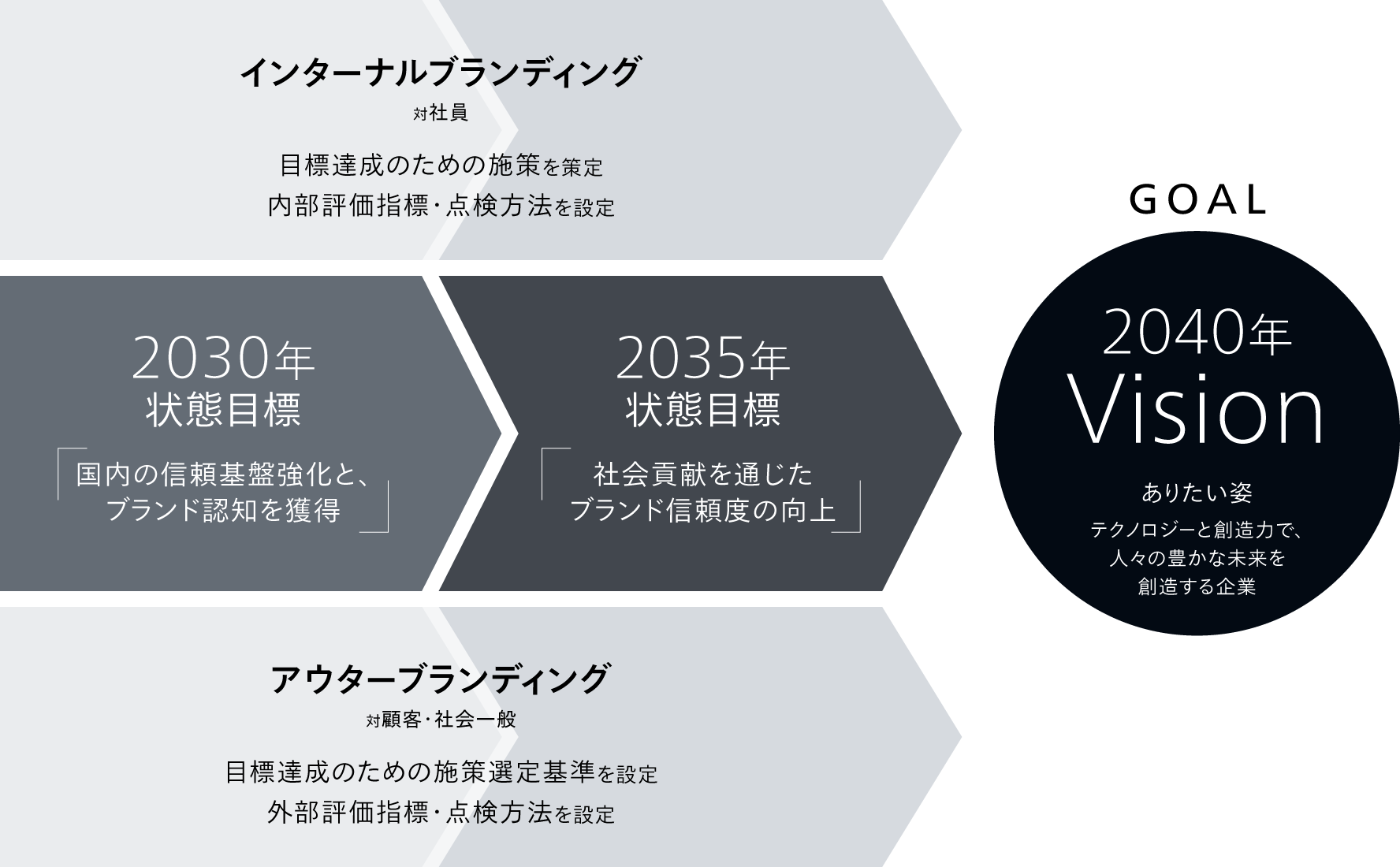
For such cases, creating an action plan is highly effective. Based on their purpose or long-term vision—the future state they aim to achieve—their vision of the future state—we break it down into three-to-five-year intervals aligned with their mid-term management plan. Within each interval, we establish a concrete “future state” to achieve. Then we determine which initiatives are required to reach that state.
By setting these for each stakeholder group, the purpose and long-term vision become actionable steps rather than abstract ideals. Recently, demand for this kind of support has grown considerably. Companies are increasingly aware that brand strategy is inherently a long-term endeavor.
— Many companies create a brand strategy or purpose, but it ends up becoming “a document that sits on a shelf.” How can they avoid that?
Shimotsuma: As I mentioned earlier, clearly defining futurestate goals is highly effective. If the purpose serves as the organization’s “North Star,” then these goals are the milestones along the path toward it. For example, a company might envision the state it wants to reach three years from now, the kinds of behaviors it hopes employees will exhibit six years from now, or the way it wishes to be described by customers in the future. By articulating and sharing these envisioned states, organizations can prevent their brand strategy from becoming something that merely exists on paper, ensuring it genuinely guides their actions.
— What is necessary to activate the organization and get teams moving during execution?
Shimotsuma: Executive commitment is absolutely essential. I would even say everything depends on whether leadership is genuinely committed. I always encourage leaders to speak about branding in their own words. When leaders convey, with real conviction, “This is the future I want to create with you,” it resonates more deeply than anything else.
However, top-down alone is not enough. If employees feel,
“What does this have to do with my job?”
things will stall. “Personal ownership” is crucial.
For example, holding regular workshops where each department discusses:
“What can we do in our work to help achieve the purpose?”
These initiatives are incredibly effective in bridging strategy and day-to-day behavior.
— So gaining employees’ understanding is essential. What can companies do to achieve that?
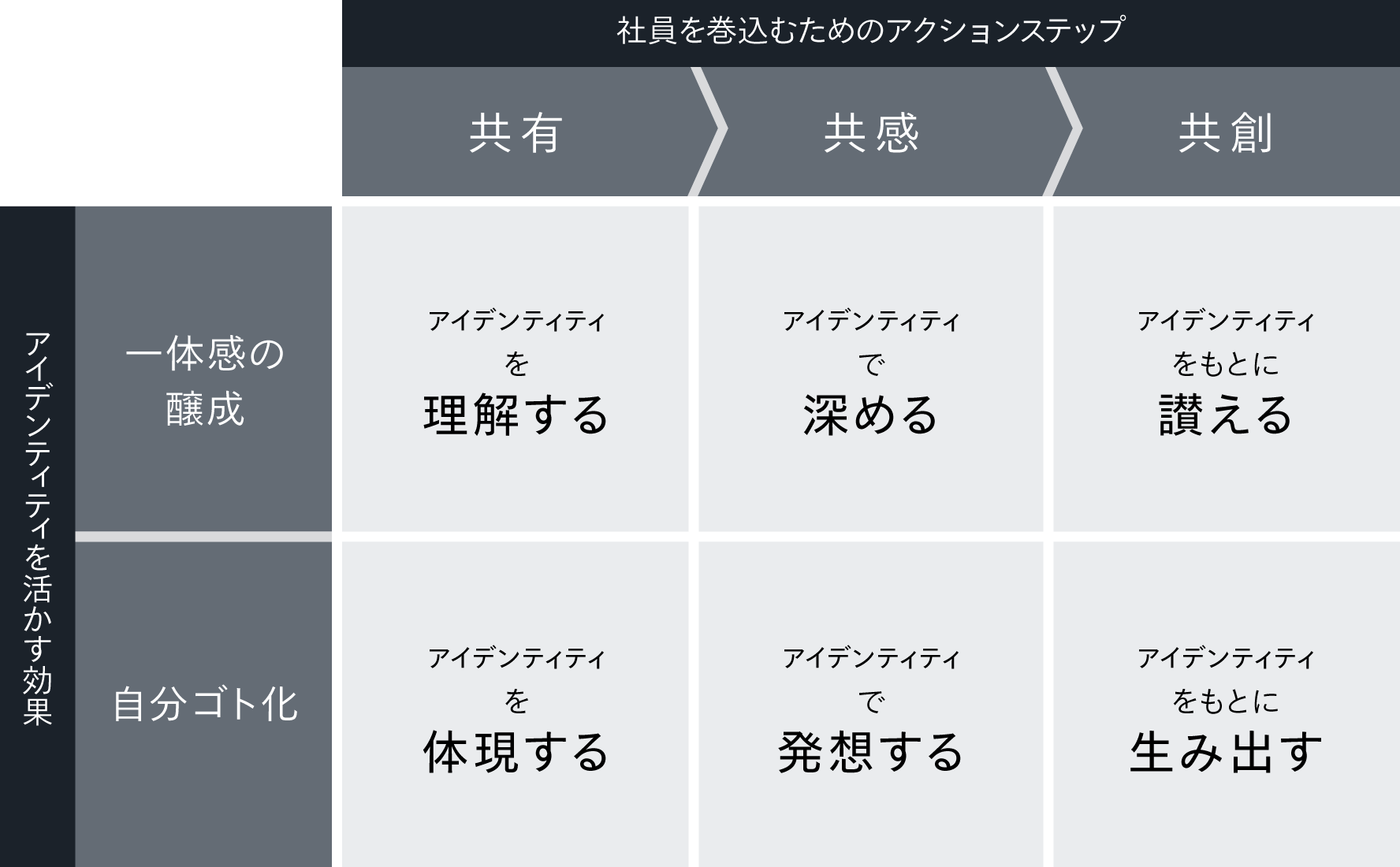
Shimotsuma: Internal branding is indispensable. It refers to initiatives that help each employee internalize the brand as something personally meaningful and embed it into their daily work. To begin with, sharing the brand strategy through internal newsletters or posters is highly effective; repeated exposure makes the message feel familiar and naturally ingrained. Grassroots accumulation like this works best.
To cultivate empathy, it is also effective to share stories of employees who embody the brand, encouraging others to reflect on what kinds of behaviors truly represent who they are as an organization and what actions they themselves might take. From the perspective of driving execution, companies can recognize and reward employees who exemplify the brand or link performance evaluation criteria to brandaligned behaviors. It is equally important to design mechanisms that put frontline employees at the center. Creating initiatives that employees find enjoyable and motivating is a key aspect of successful internal branding.
— How will brand strategy change with AI?
Shimotsuma: It is difficult to predict. AI is incredibly useful, and we also make active use of it. But branding is ultimately about building emotional connections between people. In that sense, its essence remains unchanged.
In fact, the more AI evolves, the more valuable distinctly human qualities—empathy, narrative, meaning—may become. AI may advance to the point where it forces us to confront deep questions about “what it means to be human,” but even then, I believe the fundamental nature of branding won’t change.
AI can help process large amounts of data and generate hypotheses. But deciding “This is the future we choose” is ultimately a human decision. I believe that the collective force of human intent and passion is what creates a brand.
— Finally, what message would you like to send to executives and brand leaders?
Shimotsuma: A remark from an executive I once met has stayed with me:
“A brand is not built with money—it is built in the human heart.”
Brand strategy is the act of choosing your own future. The future is not merely an extension of the present. You decide what kind of company you want to be, what kind of society you want to help create. And then, together with your stakeholders, you walk toward that future.
Branding changes employees’ expressions. It changes customer reactions. And eventually, it changes society—and the world—for the better.
I believe deeply in that transformative power of branding, and I am grateful to accompany companies on that journey. I hope to continue supporting organizations in shaping their futures through the power of branding.
.jpg)
Consulting Director
2005
Joined Gramco
2026.01.26
Gramco Insights 09
2026.01.13
Gramco Insights 08
2025.11.24