Ayako Shimotsuma
Consulting Director
2005
Joined Gramco
In the first installment, Shimotsuma discussed the essence of brand strategy and its relationship with management. In this second installment, we explore how she works alongside clients throughout actual branding projects.
Gramco Insights 08

— When developing a brand strategy, which perspectives do you consider most important? Is there anything you regard as essential?
Shimotsuma: Above all, I value the stakeholder perspective. Branding is fundamentally about creating emotional connections with stakeholders. To foster that connection, it’s not enough to simply say, “This is who we are.” What truly matters is identifying the points of engagement—how and where we can connect with stakeholders based on the way we wish to be perceived.
For instance, merely asserting “This is our strength” can feel self-centered, or at best leave stakeholders saying, “I see.” Instead, we must translate that strength into stakeholder value—what benefit it brings them. Reframing ourselves from their point of view is the first step toward forming an emotional bond.
— The term “multi-stakeholder” has become more common lately. There was a time when companies focused primarily on shareholders, but today they are expected to consider a broad array of stakeholders, including employees. In your 21 years in the industry, have you felt changes in what brand strategy must address?
Shimotsuma: Absolutely. The most significant shift in recent years has been the widespread adoption of the concept of “purpose.” More than ten years ago, brand strategy often revolved around internal and external human relationships—customer satisfaction, employee engagement, and so on. But over the past decade, companies have increasingly been asked about their role and value in society—what value they create and what role they fulfill.
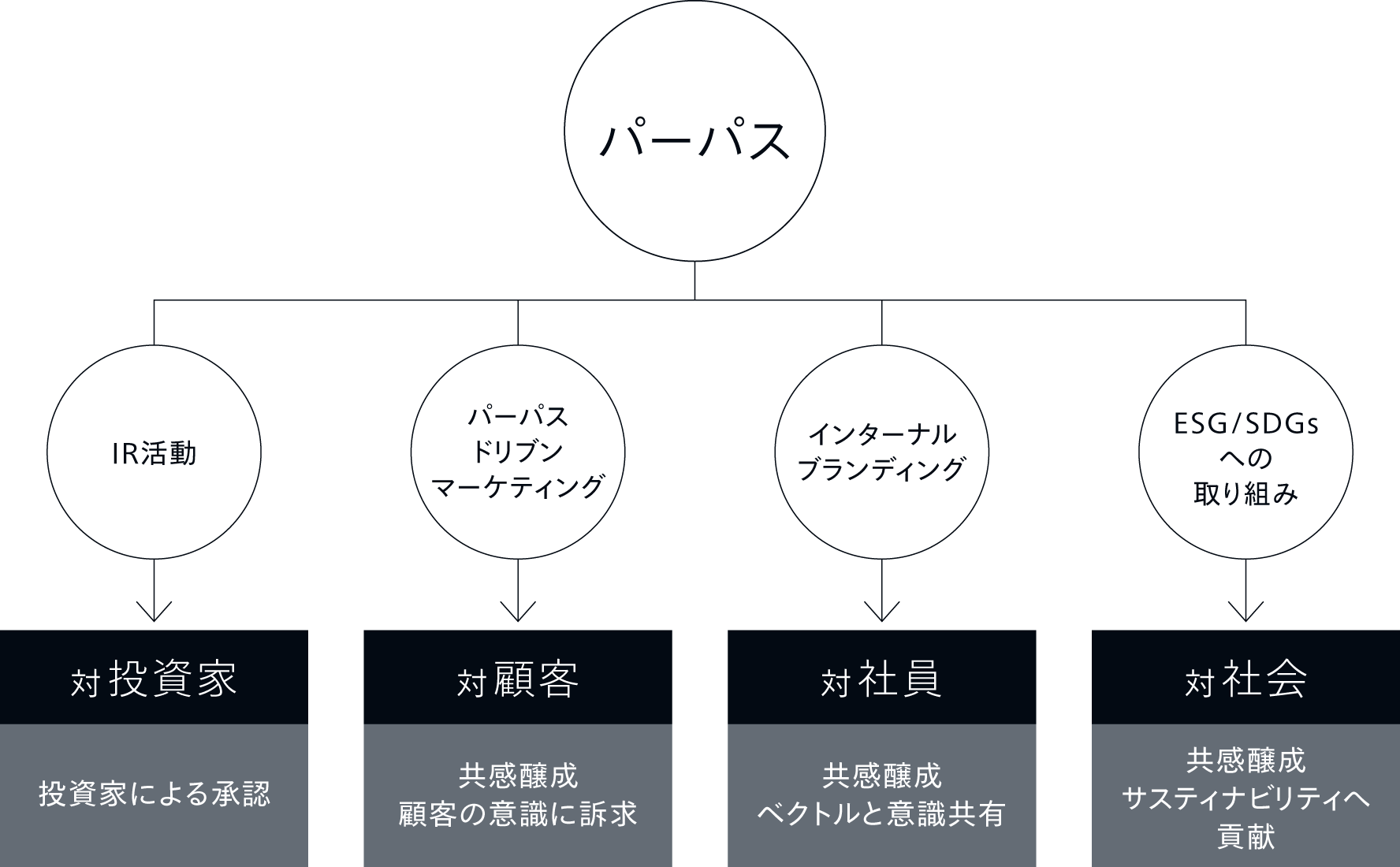
What’s fascinating is that having a clear purpose also changes employees’ mindsets. Being told “Work hard for the company’s profits” feels very different from being told “Let’s help create this kind of society—because only we can do it.” Even the same tasks feel different when driven by such a purpose. That is why branding is not just about declaring a purpose; it must guide daily actions and decision-making.
Considerations such as environmental responsibility, sustainability, and contributions to local communities—once associated mainly with CSR—have now moved to the center of brand strategy. It is no longer sufficient to think, “This is what we want to be.” Companies must ask themselves, “How should we exist for society? What can we contribute?” In that sense, brand strategy increasingly requires both a broader perspective and a long-term outlook.
— Where do you begin when developing a brand strategy?
Shimotsuma: I begin by understanding why the client wants to strengthen their brand. There is always a reason or an objective behind the desire to “increase brand power.” What do they ultimately hope to achieve? What problems do they want to solve? Once that becomes clear, we can determine how best to proceed, what options are available, and how to set priorities.
Sometimes branding begins as a response to challenges—unclear messaging, a lack of coherent direction, or the absence of a shared image to strive for. In other cases, the goal may be to compete with global brands, which requires constructing strategies and initiatives from the brand standpoint.
In any case, the most important thing is the goal—why they want to do it and what they aspire to become. Before the project begins, it is essential to fully grasp this and establish a shared understanding with the client.
— Is there anything you are especially careful about or always make a point to do?
Shimotsuma: I always read the company’s history. A company’s history contains its origins and what it has valued over time. Understanding why it was founded and how it has evolved allows me to intuitively grasp why the company is the way it is today.
I also try to visit actual sites whenever possible. If it’s a factory, I tour it; if it’s a hotel, I stay there. I pay attention to the people, the atmosphere, the sounds, the smells, and the feel of the environment. I believe it’s extremely important not to understand a client solely through documents, but to grasp them physically and experientially.
— After gathering information, how do you turn it into strategy?
Shimotsuma: It’s a meticulous and time-consuming process. First, I organize all the information collected. With the goal in mind, I identify what can serve as the strategic foundation—such as the company’s DNA, strengths, competitive advantages, and uniqueness—while also clarifying the challenges. At this stage, the outline of the strategy starts to take shape.
However, branding is about creating emotional connections. Simply presenting accurate facts isn’t enough. To develop a powerful brand strategy, you need words that move people—especially those inside the organization. Words that create unity and momentum.
Words that make people think, “This is who we are.” Words that inspire effort. Words that instill pride. As I organize information, I reflect deeply on what I have learned and search for that one defining phrase. Sometimes it arrives as a flash of insight; other times I pore through dictionaries in search of it. By going back and forth between structuring the information and searching for the right words, we eventually reach a brand concept that satisfies both logic and emotion.

— What do you value most when finalizing a brand strategy?
Shimotsuma: What matters most is whether the client feels, “We can do this—we can move forward.” No matter how strong the strategy is, nothing progresses unless the client feels that way. In the end, it is the client—not us—who must put the strategy into action.
To achieve that, we must explain thoroughly and sincerely. If that still isn’t enough, it may mean we are missing something—or that there is a background factor preventing alignment. In any case, we must continue making the effort to stay close to the client and strive to genuinely understand them.
— What if the client’s feedback is unclear?
Shimotsuma: Then we must continue exploring. Are we overlooking something? What is the true intention? Sometimes the issue stems from differences in perspective between management and frontline staff, or from the involvement of too many stakeholders, which creates ambiguity. In such cases, we return to the fundamental purpose established at the beginning—why we are branding in the first place—and help elevate perspectives, broaden viewpoints, and shift focus from the short term to the long term. In doing so, we support sound decision-making and consensus-building.
◇
In this second installment, Shimotsuma discussed the perspectives she values and the practical methods she employs in her work. In the final installment (Part 3), she will speak about clients’ concerns, internal branding, brand strategy in the age of AI, and her message to corporate leaders.
.jpg)
Consulting Director
2005
Joined Gramco
2026.01.26
Gramco Insights 09
2026.01.13
Gramco Insights 08
2025.12.08