
2005
Encountering Branding
―― First, could you tell us about your career and how you first encountered branding?
Shimotsuma: I previously worked for a company in the service industry. A project to launch a new brand was initiated there, and I was selected as a member. At the time, I had never thought deeply about branding, so I started from the question, “What is branding ?”
There were many things to consider in the project—target audiences, value propositions, and more—but honestly, at first it didn’t quite click. However, through discussions with colleagues and reading books, I gradually realized, “Branding isn’t just about appearances—it’s a much bigger theme that questions the very essence of what a brand is.” From that point on, it became increasingly fascinating.
Around that time, I also read a book written by our company’s CEO, which had a significant impact on me. I was struck by the realization that “There was work that could influence a company or brand to this extent.”
Later, when I began considering a career change, I remembered that book. I thought, “I want to specialize in branding,” and decided to apply.
After joining the company and becoming involved in actual projects, I truly came to understand the depth of branding. I realized that a superficial understanding would never be enough to practice real branding. Even so, my intuition that “this is absolutely fascinating” proved correct. The past 21 years have been a continuous journey of learning in the field.

Taking on Island Branding in My First Year
―― Among the projects you’ve worked on over the past 21 years, is there one that stands out?
Shimotsuma: There are many, but the first that comes to mind is the remote island branding project commissioned by the Cabinet Office that I worked on in my first year. It targeted remote islands in Okinawa Prefecture. There were no internal precedents, and it didn’t fit into any of our existing frameworks. We truly had to build everything from scratch.
In addition to developing the strategy, I also had to manage administrative tasks—coordinating a committee composed of experts from various fields and communicating with related parties. For someone in their first year, it felt like a heavy responsibility. However, it became an invaluable experience, allowing me to learn about Okinawa’s remote islands, different expert approaches, and how national government projects operate.
―― Have there been projects that progressed smoothly? Are those the most enjoyable?
Shimotsuma: Of course, some projects do move forward smoothly. But I wouldn’t necessarily say that “smooth” equals “fun.” Regardless of the project, high-quality output is always required, and there is constant pressure.
That said, there were moments when I truly felt the power of design—and those were enjoyable. When the ideas we’ve discussed at length became visible, and new possibilities and options were presented to us, I could see our clients’ eyes light up. At those moments, I was reminded of how incredible design could be—and I sometimes even felt a little envious of designers.
The Definition and Meaning of Brand Strategy
―― How would you define brand strategy?
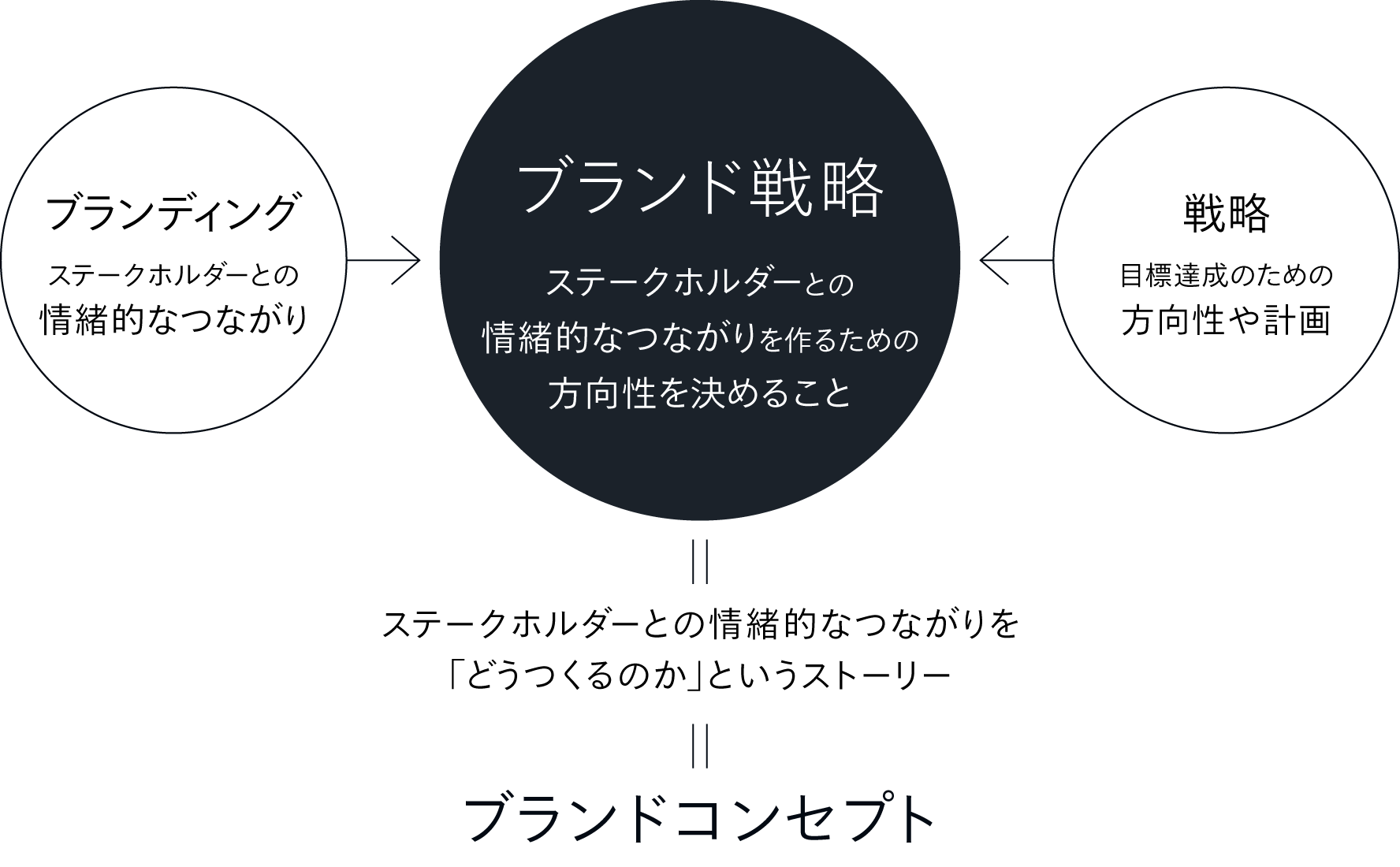
Shimotsuma: I’ll use “brand” and “branding” interchangeably here. Branding is the act of creating emotional connections with stakeholders. Strategy, on the other hand, is the overarching direction or plan for achieving long-term goals. Therefore, brand strategy can be defined as “determining the overarching direction for building emotional connections with stakeholders.”
In other words, it is about deciding the story of how those emotional connections are formed. At our company, we call this the brand concept.
What kind of brand do we want stakeholders to perceive us as? Where do we want to position the points that generate empathy? Once this overarching direction—the brand concept—is established, the necessary tactics and initiatives naturally follow. From business implementation to communication, all activities become aligned under a single coherent thread.
Management Strategy and Brand Strategy
―― How do you see the relationship between brand strategy and management strategy?
Shimotsuma: Personally, I see brand strategy as the “heart” of management strategy. If management strategy functions like a command center—deciding “Which markets will we compete in?” and “Which businesses will we grow? ” to ensure sustainable growth—then brand strategy answers more fundamental questions: “Why are we doing this in the first place?” “What kind of existence do we aspire to become ?” “What value do we provide to connect with society?”
No matter how correct the directives may be, unless people’s hearts are moved, individuals—and the organizations they form— will not truly act.
Perhaps brand strategy is what gives management strategy its lifeblood and warmth. It connects strategy to human emotion and action within people and organizations.
◇
In Part 1, we explored how Shimotsuma first encountered branding, the essence of brand strategy, and its relationship to management strategy.
In Part 2, we will delve deeper into how strategies are developed in real project settings and how they evolve alongside clients.
Latest Thinkings
How Will Brands Evolve in the Age of AI? #2 Speaking About the Essence of a Brand With Responsibility
2026.01.26
How Brands Will Evolve in the Age of AI – #1 “Nurturing and Guiding AI as a Highly Capable Subordinate”
Gramco Insights 09
2026.01.13
A Brand Is Nurtured Through Empathy — #3 Brands Are Built in the Human Heart
Gramco Insights 08
2025.12.08